Zwei neue und gleichzeitig bekannte Gesichter in unserem Team
Zwei neue und gleichzeitig bekannte Gesichter in unserem Team

That question has no clean answer yet for scheduling under hard temporal constraints. A new paper from our research group Industrial Deep Learning tackles it head-on. Marvin Brune, Elias Theis, Constantin Waubert de Puiseau, Dr.-Ing. Hasan Tercan and Tobias Meisen just had their work accepted at PRICAI 2026 (Pacific Rim International Conference on Artificial Intelligence). Not by claiming learning wins, but by measuring where it doesn't.
The setup: deep reinforcement learning scales well and builds strong schedules, but maximal temporal constraints - an operation must start within a fixed window of another, or the whole plan breaks - are the classic stronghold of exact solvers. Violations often surface only late in construction, exactly where a constructive learner is weakest.
Three contributions:
→ A new problem formulation, FJSP-JPTC, extending the Flexible Job Shop Problem with job-precedence and minimal/maximal temporal constraints, with a public benchmark for several problem sizes.
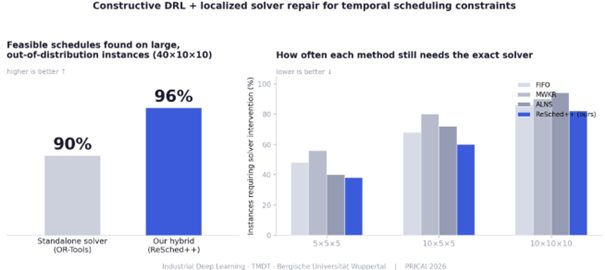
→ A hybrid that plays to both sides. A constructive DRL policy (a ReSched extension with dedicated temporal branches and a learned control barrier function) builds a full schedule end-to-end. A solver then repairs only the operations involved in a violation, no costly global re-optimization. A reward that penalizes solver reliance pushes the agent to need that repair less and less over training.
→ An honest measurement of the boundary. The learned model triggers solver intervention up to 20% less often than common dispatching heuristics and 12% less than a strong metaheuristic (ALNS). On large out-of-distribution instances it produces feasible schedules 96% of the time, against 90% for a standalone exact solver, at negligible extra overhead. But the solver stays indispensable: sparse rewards still can't capture the long-range dependencies that maximal temporal constraints demand.
That last point is the one we care about most. The path from benchmark to production floor isn't paved by bigger models, it's paved by methods that take constraints, trade-offs and feasibility guarantees seriously, letting a learner and an exact solver each do what they do best. We're testing this line in the project Flex4Green, where scheduling has to hold up against real operational constraints.
Code and benchmark will be released publicly with the conference.
Flex4Green is funded by Bundesministerium für Wirtschaft und Energieproject management agencyDLR Projektträger
Weitere Infos über #UniWuppertal: