Zwei neue und gleichzeitig bekannte Gesichter in unserem Team
Zwei neue und gleichzeitig bekannte Gesichter in unserem Team

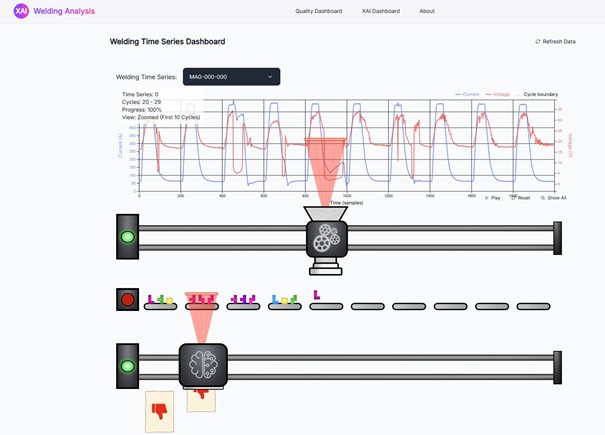
In June, Yannik Hahn is presenting EXCODER at PAKDD2026, the 30th Pacific-Asia Conference on Knowledge Discovery and Data Mining, in Hong Kong. The work comes out of our Industrial Deep Learning (IDL) research group.
The problem EXCODER tackles: deep learning models for time series classification are accurate but opaque. Standard XAI methods struggle with raw signals, they are too high-dimensional, too noisy. EXCODER takes a different route. It transforms the time series into discrete latent representations (via VQ-VAE / DVAE), so explanations operate on a compact, structured space instead of the raw signal. The result: explanations that are more concise and more stable, without trading away classification performance. On top, we introduced SSA (Similar Subsequence Accuracy), a metric that checks whether the patterns an XAI method flags as important actually recur in the training data, rather than being spurious correlations.
But a paper is one thing. What we find more telling: the same approach runs as a XAI dashboard on real arc-welding data. There you can see it directly, which subsequence of the current-and-voltage signal made the model call a weld as defect, and how reliable that explanation is given the training distribution. That's the step we care about: an explainability method that doesn't stay on a benchmark, but tells a process engineer why.
EXCODER is part of a longer line of work in the research focus Temporal Representation & System Understanding at IDL, led by Yannik Hahn. Industrial AI has to hold up in production: reliable, data-efficient, and explainable for the people who actually work with it!
Weitere Infos über #UniWuppertal: